


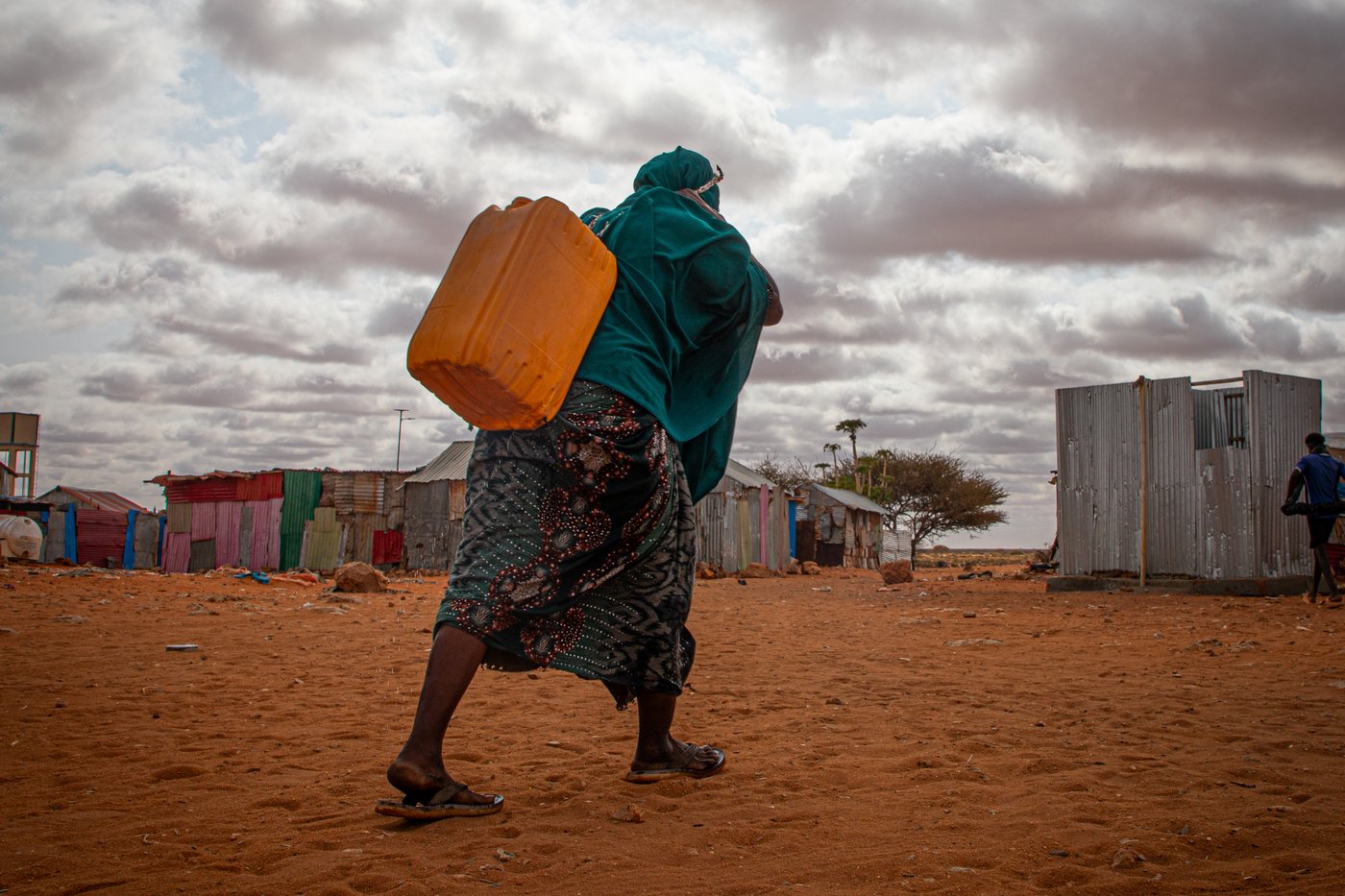
Twenty litres of water for ten people. That was what Sharifa, a displaced mother in Xaar-xaar camp, Galkacyo, Somalia, brought home after walking for hours each day.

The long walk for clean water is over
The mother of eight needed that water for drinking, cooking and washing. By the time it was divided among her family, there was little to spare. The next day, she would make the journey again.
Sharifa and her children had already been forced from their home by conflict. In the camp, finding enough water became another struggle, one that demanded her time and energy every day.
Now, a newly drilled, solar-powered borehole supplies clean water close to her home.
“We now have clean water right on our doorstep,” Sharifa says. “I no longer worry about finding water for my family.”
The borehole was constructed by the Norwegian Refugee Council (NRC) through the Joint Resilience Programme (JRP), in partnership with the World Food Programme (WFP) and with funding from Germany’s KfW Development Bank. For Sharifa, its importance is measured in the hours she no longer spends walking and the relief of knowing that water is nearby.
For a long time, Sharifa and other displaced families in Xaar-Xaar struggled to access clean water. Her daily journey brought back just one 20-litre jerrycan for a family of ten. That amounted to two litres per person, before accounting for all the different ways a family uses water throughout the day.

Drinking, preparing meals and washing drew from the same container. The supply could not adequately cover them all.
Collecting the water was only part of the task. Once Sharifa returned, she still had to make it stretch across the family’s needs. The effort of carrying it home did not change how little there was.
For a parent caring for eight children, water is needed throughout the day. There is food to prepare, hands to wash and household items to clean. These needs continue even when the jerrycan is running low. A family cannot put them aside until access improves.
Sharifa’s experience shows how the lack of a basic service can make daily life harder after displacement. Conflict had forced her family to leave home. The shortage of water then became a problem they had to manage repeatedly in the place where they sought safety.
The hours spent on the journey were hours she could not spend on other responsibilities. Carrying the water required physical effort, and the routine had to be repeated because the family depended on what she brought back.
Her account is straightforward: the walk was long and the water was not enough.
For displaced families, this is why the location of a water source matters. Having water available somewhere is different from being able to collect it easily. When reaching it takes hours, the distance becomes part of the hardship.
The new borehole has shortened that distance for Sharifa. She can now collect clean water in her neighbourhood, without the journey that used to occupy so much of her day.
“We now have clean water right on our doorstep,” she says.
There is relief in those words. Water is no longer something she must travel for hours to bring home. It is close enough to become a more manageable part of her routine.
“I no longer worry about finding water for my family,” she says.
Her words describe the result more clearly than a description of the water infrastructure alone could. The borehole matters because it answers a need she faced every morning. She knows where her family’s water will come from, and reaching it no longer takes hours.
Solar panels provide the energy to power the new borehole. Through the partnership between NRC and WFP, and funding from KfW, the system brings clean water closer to displaced families in Xaar-Xaar.
For Sharifa, the most immediate change is practical. The distance is shorter and the water is close to home. A task that once required a long walk is easier to carry out.
Sign up to our newsletter to read more stories from around the world.
