
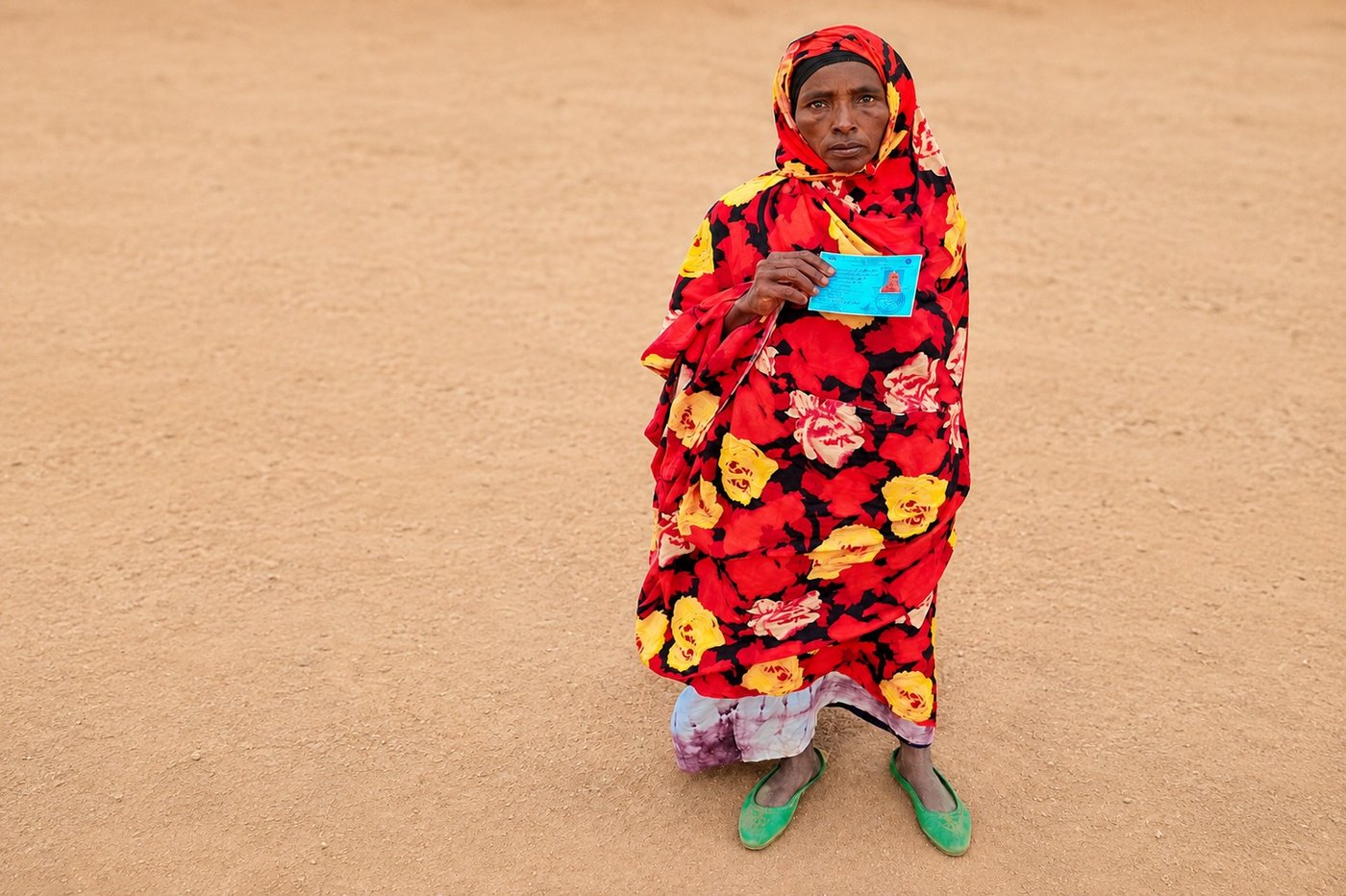
Faadumo, 45, was carrying a sick child toward the only hospital that could treat him when a police checkpoint on the road to Negele stopped her. She had no kebele ID – also known locally as a mustaqe – and could not prove who she was or where she belonged.
Securing the right to move
Faadumo fled the Dawa zone, on the border with the Oromia region, when ethnic conflict broke out between Oromo and Somali communities in Ethiopia. She resettled in Muqli village, Dheka Sufti district, Liban zone, with her seven children and without the paperwork that would let her move freely or reach the services her family needed.
That absence became a crisis the day one of her children fell seriously ill.
“One day, one of my young children became seriously ill,” Faadumo says. “I attempted to travel to Negele for medical treatment. However, I was stopped on the road by local police because I did not have the required local identification document.”
After negotiating with the police, they eventually let her pass. She reached the health facility, and her child was treated.
But the checkpoint was not the end of it. Back home, Faadumo faced another challenge: the cost of processing the identification papers she knew she needed. She could not afford it. Without the documents, the restrictions on her movement and on her children's access to services continued to be hindered.
Through the fund from Ministry of Foreign Affairs, the Norwegian Refugee Council (NRC), ran community awareness sessions on the importance of civil documentation and legal identity. When Faadumo's case came to the attention of our information, counselling and legal assistance (ICLA) team, they gave her tailored legal counselling, coordinated directly with local authorities, and supported her through the process of obtaining a local identification card.
The processing fees remained a barrier even after that. NRC covered the cost, and Faadumo received her documentation.
With that support, Faadumo was finally able to access essential services and move more freely, without fear of being stopped again.
Faadumo can travel to seek healthcare for her children without any fear or worries and remains unfettered. She accesses services that were, for years, out of reach, not because the road changed, but because she can finally prove who she is on it.
Sign up to our newsletter to read more stories from around the world.
