


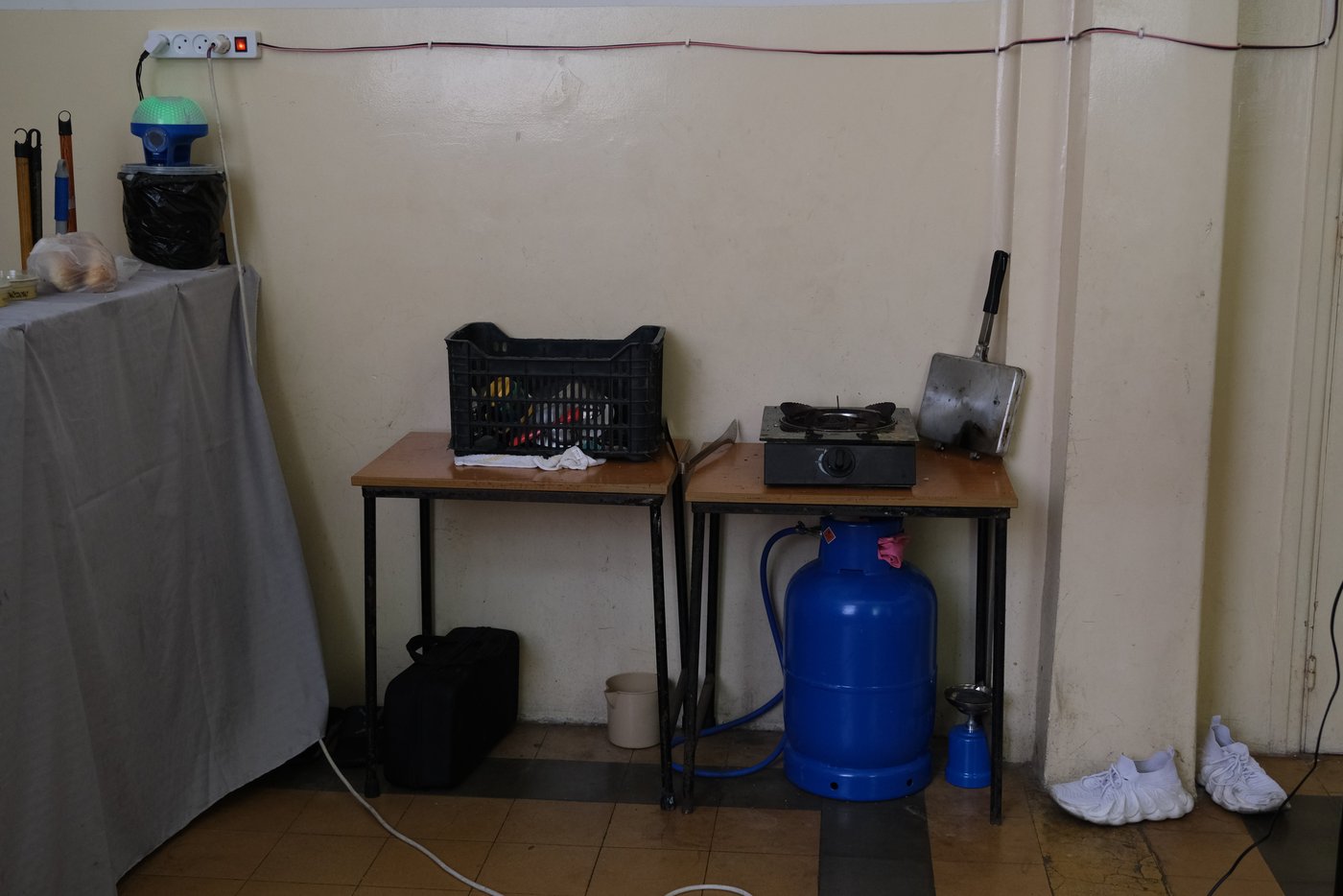
The desks have been pushed aside, and a classroom has become the place where Mahmoud’s family sleeps, eats and waits for a chance to return home.

No home to return to
Mahmoud and his family were first displaced from Mays Al Jabal, a border village in southern Lebanon, at the start of the cross-border hostilities between Lebanon and Israel in October 2023.
Since then, repeated escalations, ceasefire announcements and agreements have brought cycles of hope and disappointment. Each time a ceasefire was announced, families hoped they would finally be able to return. But for many, including Mahmoud’s family, return remained impossible.

An entire life in a classroom
During the latest escalation of hostilities between Lebanon and Israel in March 2026, more than one million people were displaced, and hundreds of thousands sought safety in schools repurposed as collective shelters. Following the halt in large-scale attacks, some families returned to their villages. But many remain unable to go back. For some, it is still too dangerous. For others, including Mahmoud’s family, there is simply nothing to return to as their village has been reduced to rubble.
Mahmoud, his wife, their children, and grandchildren currently live inside one of these schools. A space once meant for students and lessons now holds a family’s entire daily life.
The classroom offers little privacy, little comfort and little dignity. Hundreds of people in the school depend on a limited number of bathrooms and toilets. A simple routine like washing your face, taking a shower, or using the toilet, requires waiting your turn and planning around others.
“We have to schedule our toilet times. It’s not easy here,” says Mahmoud’s wife. “Most nights, I wait until two in the morning to take a shower so no one will knock on the door.” Only then can she take a shower without being rushed or interrupted.
“We can’t even imagine our future”
Each ceasefire announcement brought hope that their suffering might finally end, but those hopes have repeatedly faded.
“We have no hope anymore. We can’t even imagine our future,” Mahmoud says. “We lost our home, our land, and our memories. We are from the border village of Mays Al Jabal. My house was demolished by the Israelis.”
Leaving the shelter is not an option. Rent is too expensive, while the family is struggling to afford even the most basic needs.
“We can barely afford bread. So, we need to stay here.”
He pauses before pointing to his six-month-old grandson.
“I don’t care much about myself anymore. This baby is the reason I want to survive. I want him to have a better and safer life. I want him to have a future, because in the life we’re living now, we can’t even dream about tomorrow.”
Generations of uncertainty
Mahmoud has lived through conflict for most of his life. What pains him most is seeing the same fear and uncertainty passed on to another generation.
“I’m not young anymore. I was born during war, I grew up in war, I raised my children during war, and now my grandchildren are growing up in war. I hope my family will finally know a different future.”
Still, despite everything he has lost, Mahmoud’s connection to his village remains stronger than his desire to leave.
“Sometimes I say I want to leave this country if I ever get the chance. But if I could return to Mays Al Jabal today, I wouldn’t hesitate. I’d set up a tent and live there, even if all that remains of home is the land beneath my feet. It’s my home, my village, my land.”
The story of thousands
Displacement has transformed lives in unimaginable ways. Families who used to help others through difficult times are now the ones struggling to meet their most basic needs and relying on humanitarian aid to survive.
This is Mahmoud’s story. But it is also the story of thousands of families in Lebanon whose homes, routines, and futures have been overturned by ongoing hostilities and repeated escalations with Israel since October 2023.
Sign up to our newsletter to read more stories from around the world.
