
Climate shocks, population displacement, armed violence and insecurity have had a profound impact on Mali for many years. These multiple crises have made the population more vulnerable, with devastating effects on economic and natural resources, as well as on the daily lives of communities. Many communities have suffered heavy material and human losses, in addition to trauma.
Since 2012, Mali has been facing a humanitarian crisis as a result of the conflict in many regions of the country. This crisis has been exacerbated by climate change in the form of droughts and floods. In July 2024, the country experienced exceptional rainfall – the heaviest since 1967 – affecting almost all regions. Some 385 cases of flooding were recorded across 19 regions and the Bamako Capital District, and 31,304 buildings collapsed.
There were also eight cases of electrocution caused by lightning, and six cases involving strong winds and sandstorms. In total, 208,448 people were affected by the extreme weather events, including 83,517 children. The regions of Ségou, Timbuktu, Gao, Bamako, Ménaka and Mopti saw the highest number of people affected.
During the rainy season in 2025, Mali again saw thousands of people affected by disasters, with several injured. These successive crises highlight the country’s vulnerability to the risks posed by climate change. Furthermore, by the end of 2025, according to the National Directorate for Social Development (DNDS), nearly 415,000 people were displaced within the country, of whom 58 per cent were children and 4 per cent were older people.
Strengthening local capacity
The Norwegian Refugee Council (NRC) and its partner AMSODE are helping to strengthen communities’ resilience to crises and climate-related shocks through a project called “Strengthening local capacities for disaster preparedness and response in the northern and central regions of Mali”, funded by the European Union.
The project’s objective is to reduce the impact of multi-hazard shocks by improving governance. It aims to strengthen the skills and capacities of decentralised, community-based authorities to prepare for, monitor and respond to sudden multi-hazard shocks, and to improve the coordination of disaster preparedness.
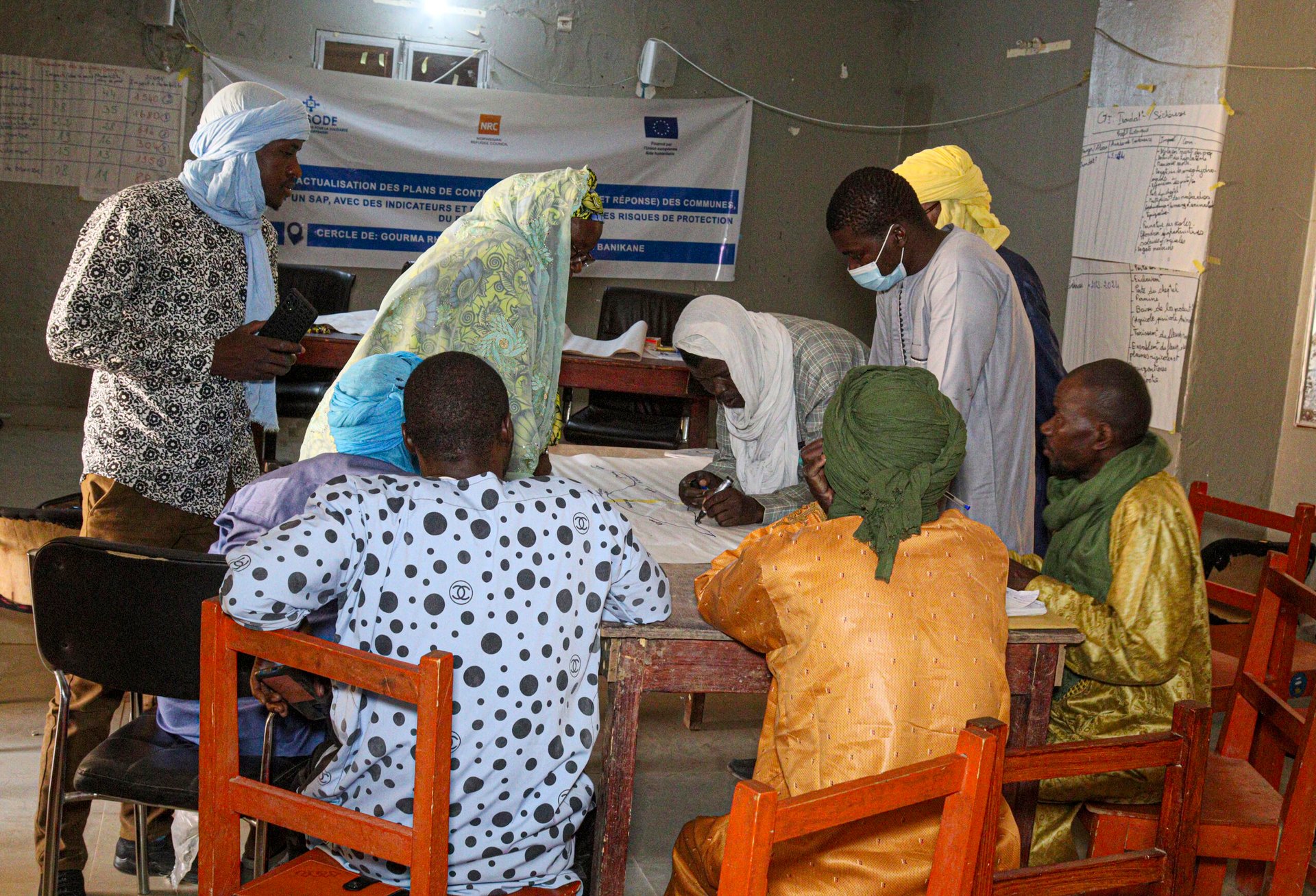
As part of the project, a survey of local risk management mechanisms was carried out in the six municipalities of Anchawadj, Gounzoureye, Bourem, Ansongo, Banikane and Seréré. Workshops to develop contingency plans were also organised in the Gao and Timbuktu regions, focusing on the same six municipalities.
The workshops were attended by representatives from institutional, technical, municipal and community authorities. These meetings helped to foster dialogue between humanitarian actors, technical services and public authorities, building a shared understanding of risks and the mechanisms for triggering responses.
A culture of disaster preparedness
The project helped to establish a culture of disaster preparedness through participatory risk assessments, simulation exercises, the regular production of early warning information and the development of local monitoring and response mechanisms.
The capacities of institutional, community and technical stakeholders were strengthened, as were the early warning systems at regional and national levels. NRC and AMSODE also carried out capacity-building activities through the training provided Bioforce.
Disaster preparedness (DP) and response are essential to minimising the impact of crises and protecting lives. In order to better coordinate responses, DP and response stakeholders have held quarterly coordination meetings to facilitate the sharing of experience, synergies in action, consistency in responses and the exchange of best practice.
Finally, capacity-building for the Local Monitoring and Reporting Committees (CLVRI) on information collection and reporting has improved the reliability of risk monitoring and the responsiveness of communities. To better prepare communities and local authorities to cope with disasters, six municipal contingency plans were drawn up, followed by simulation exercises in the Timbuktu and Gao regions.
In response to multiple shocks, NRC and AMSODE carried out needs assessments and provided cash assistance for shelter, food and essential items for 672 households affected by the floods in the Gao and Timbuktu regions – more than 3,000 people – with the support of the European Union. This assistance was vital in helping the affected communities to overcome their challenges.
Sign up to our newsletter for regular updates on the global refugee situation.
