

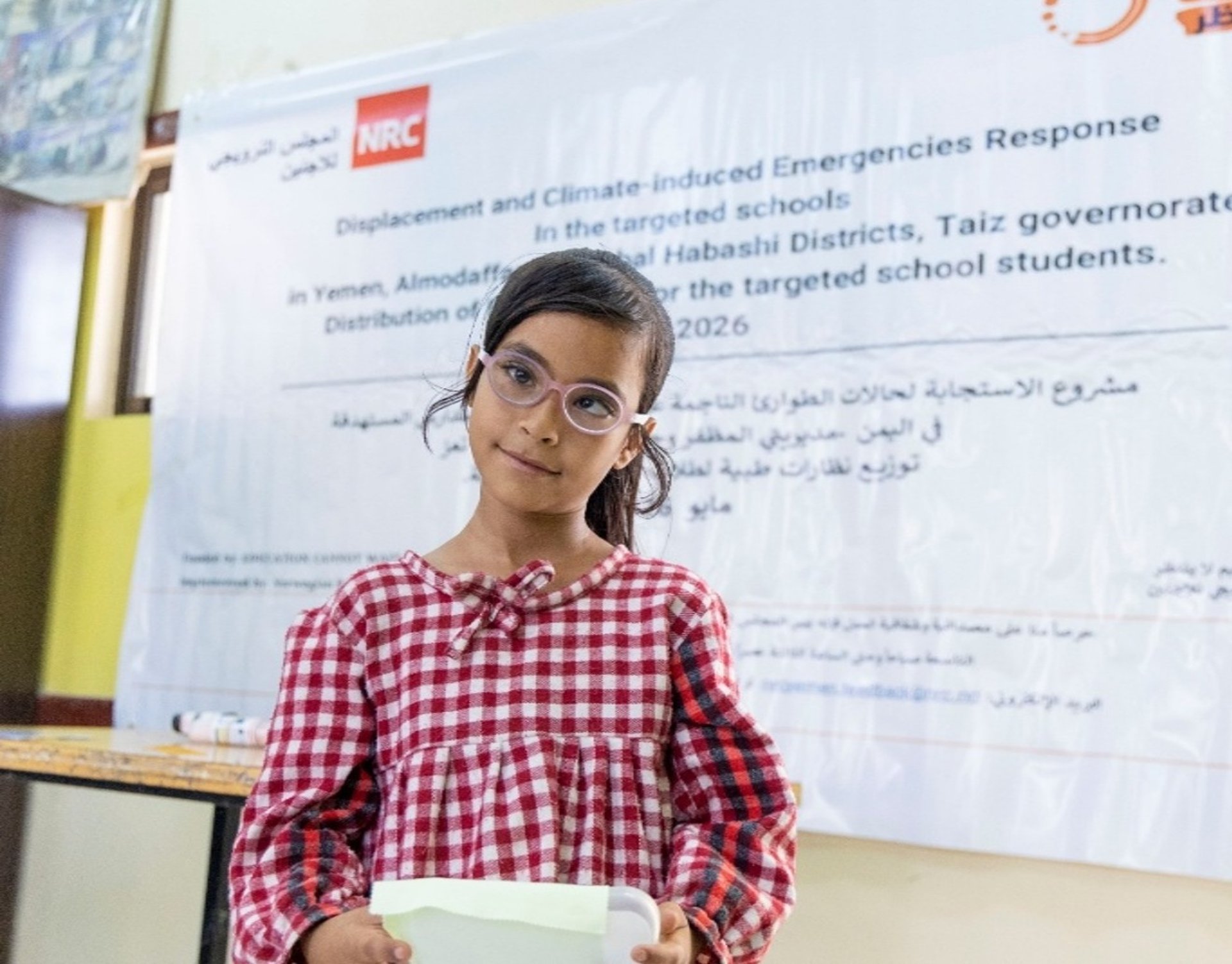
For nine-year-old Maryam, the classroom used to fade into a blur just past her desk. She lives in a borrowed house in Yemen, sharing a single room with her grandfather, parents and five siblings. Her father works long hours driving a motorcycle – the family’s only source of income. When daily wages barely cover food for a family of eight, a pair of prescription glasses is a luxury entirely out of reach.
So, Maryam faced this frustrating barrier quietly. She couldn't read the blackboard. Her head constantly ached, and the lessons left her feeling isolated from the children sitting right next to her.
Across conflict-affected regions of Yemen, families are making impossible choices every day, placing immense pressure on children's education and wellbeing. To help keep children like Maryam in the classroom, a project called “Displacement and Climate-Induced Emergency Response in Yemen” was established.
This programme is supported by a US$3,000,000 contribution from Education Cannot Wait (ECW), the United Nations global fund for education in emergencies and protracted crises. Running until September 2026, the initiative is driven by a consortium partnership featuring the Norwegian Refugee Council (NRC), CARE, and the Nahda Makers Organization (NMO).
Operating across vulnerable districts in the Taiz and Al Hodeidah governorates, the initiative reaches over 28,700 students. The goal is straightforward: reduce the daily barriers to education, make schools safer, and support out-of-school children, girls and children with disabilities.
Overcoming daily hurdles
Keeping these children in the classroom requires more than just unlocking the doors. In many parts of Yemen, the education infrastructure is buckling.
"You walk into some of these rooms and there is literally nowhere to sit," says Amjad Talal, a field officer at NMO. "The noise and the crowding make teaching nearly impossible, and learning even harder."
To tackle these issues from the ground up, NRC and its partners are reshaping the physical learning environment in Taiz. Construction is underway for six new classrooms to reduce overcrowding, alongside the delivery of 540 durable desks.
The school has become an engaging and welcoming environment where children actually want to learn.Manager of the Ali Ibn Abi Taleb School
But physical space is only half the equation. Students who have lost years of learning need specialised help to catch up. For over 2,200 other at-risk students, targeted remedial classes in foundational literacy and numeracy are proving to be the bridge back to a normal education.
"We can't just teach the standard curriculum and hope they catch up," explains Abdulrazaq, an education coordinator at NRC. "Providing these remedial classes is what actually keeps them from walking away for good."
Educators are also receiving critical support to navigate these extreme circumstances, with 70 teachers receiving training in Accelerated Learning Programmes (ALP) and Teachers in Crisis Contexts (TiCC) methodologies.
"We’ve helped students catch up on the academic subjects they missed, while also building our teachers' capacities,” says the manager of the Ali Ibn Abi Taleb School.
“Between distributing school bags, providing medical glasses for children struggling with weak eyesight, and repairing the school itself, the school has become an engaging and welcoming environment where children actually want to learn. The programme was truly comprehensive and impactful."
I can read my books without getting headaches. I feel like I can learn just like everyone else.Maryam
Sometimes, the necessary intervention is incredibly personal. Through the programme, NRC actively identifies children with visual impairments, covers their transport to medical centers and provides them with eyeglasses.
For Maryam, that simple assistive device changed everything.
"I can see clearly now," she says with a smile. "I can read my books without getting headaches. I feel like I can learn just like everyone else."
She isn't just staring at a blurry blackboard anymore. She is looking toward a future where she can become a doctor, and for the first time in a long time, that future is entirely in focus.
Sign up to our newsletter to read more stories from around the world.
