


Khadija, 78, is raising six grandchildren in a displacement camp on the outskirts of Mogadishu, Somalia. They are the children of her late son, and their care is now her responsibility.

A national ID and new possibilities for Khadija
Armed conflict forced Khadija to leave her home in Lower Shabelle. She has lived in the camp in Gasbaley for more than seven years. During that time, she has faced the difficulties of displacement while caring for her family without a national identification (ID) card.
She now has one.
Khadija is among 11,000 displaced people in Mogadishu whom the Norwegian Refugee Council (NRC) has helped receive national ID cards. She hopes the document will make it easier to prove her identity and access services that her family needs.
“I am looking after my late son’s six children. At my age, caring for them is a big responsibility. I hope this card will make it easier to seek the services we need,” says Khadija.
For Khadija, the importance of the card is tied to the family she is bringing up. Daily decisions involve six children as well as her own needs as an older person. Whenever a service requires proof of identity, having the right document matters.
Without formal identification, displaced people may face additional steps, delays or difficulties establishing who they are. These barriers can be particularly burdensome for someone already managing family responsibilities with limited resources. A journey to an office, a request for further documents or the need to return another day can make an ordinary task much harder.

“After leaving our home, we had many difficulties to deal with. Not having an ID added another worry. Now I have an official document that shows who I am,” Khadija explains.
Khadija’s displacement began more than seven years ago, but its consequences remain part of her life. Leaving Lower Shabelle meant establishing a home elsewhere while living with the disruption caused by conflict. Today, her grandchildren are growing up in the camp where she has spent those years.
Caring for them gives her reasons to look ahead. Their needs continue as they grow, and she wants to be able to respond. Receiving a national ID is one practical change she hopes will help her manage that responsibility. It does not change her age, replace her home or take away the loss of her son. It does give her a means of identifying herself that she did not have before.
“My grandchildren depend on me. I want to be able to ask for help and access services without struggling to prove my identity,” Khadija explains.
NRC supported Khadija through the “Scaling Access to Inclusive Legal Identity for Displacement-Affected People in Somalia” project. Funded by the Swiss State Secretariat for Migration (SEM), the project is implemented in collaboration with the National Identification and Registration Authority (NIRA) and Banadir Regional Administration (BRA).
The project aims to support 130,000 people to obtain national ID cards. Registration activities cover displacement camps in a number of target cities in Somalia including Mogadishu, Baidoa and Kismayo, to help people affected by displacement address barriers linked to a lack of legal identity.
Khadija’s receipt of her card is an individual step within that wider effort. The next question is how she can use it in everyday life.
An ID can help a person meet identification requirements, but access to a particular service still depends on that service’s rules and availability. Receiving a card does not automatically provide financial assistance, healthcare or other support. Its role is to help establish identity when a person seeks those services.
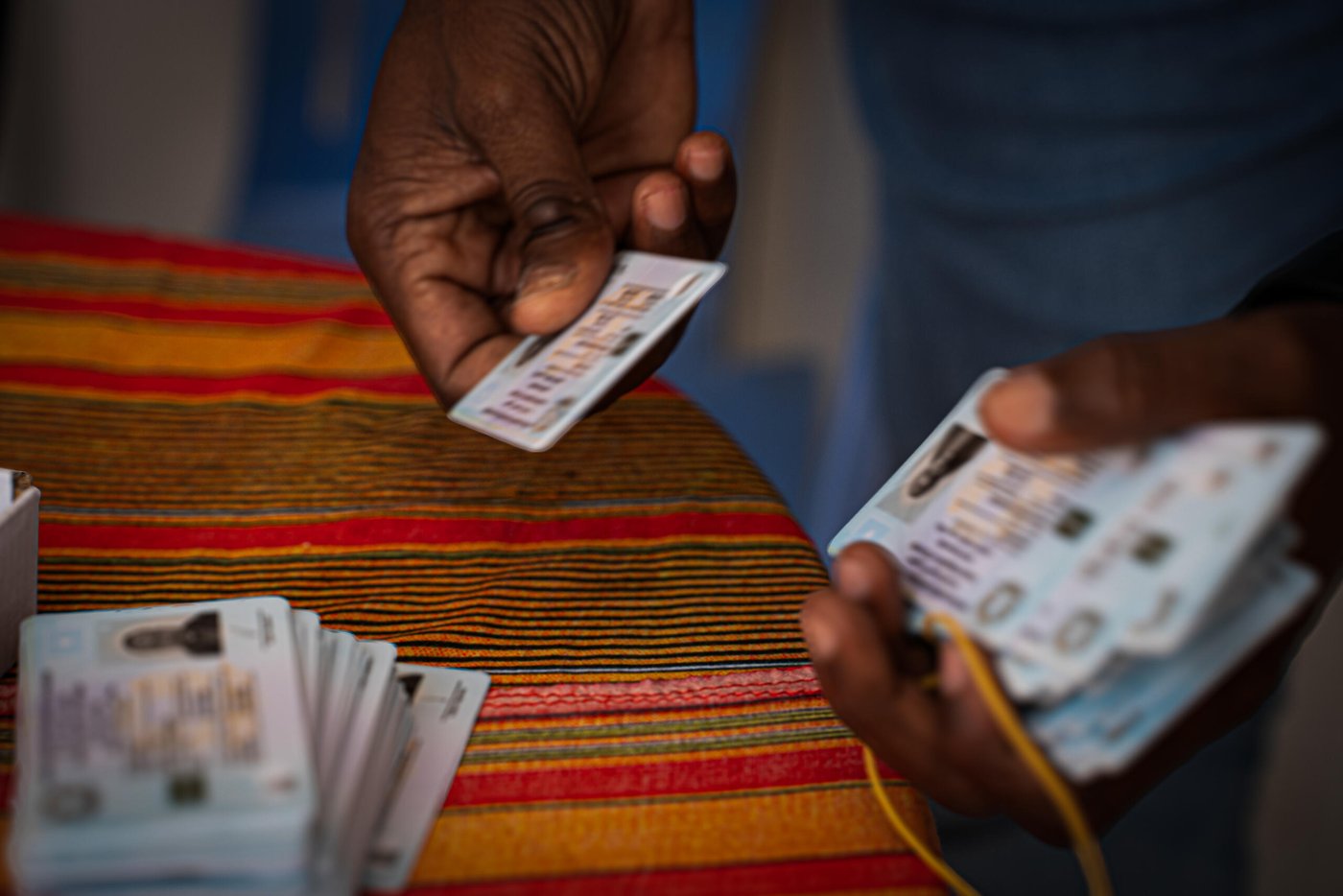
That distinction matters in Khadija’s story. She has received the document; the changes she hopes it will bring are still ahead.
“I have received my card, and I am glad to have it. I hope it will help when I go to places where identification is required,” Khadija says.
For an older caregiver, being able to present a recognised document can also bring reassurance. Khadija has spent years raising her family in displacement. She should be able to approach an office or service provider with the same opportunity to establish her identity as anyone else.
Legal identity is closely connected to inclusion in this way. People who have been forced from their homes remain members of the wider community, with rights and responsibilities. Missing documents should not leave them unable to demonstrate who they are.
The project seeks to address that gap by supporting access to national identification. Collaboration with NIRA and BRA connects the assistance to the authorities responsible for registration and local administration.
Khadija’s circumstances also show why older people and caregivers need to be included in such efforts. Their responsibilities do not disappear with age or displacement. Some, like Khadija, are bringing up children after the death of a parent. Reaching them requires attention to their situation and the obstacles they face in obtaining documents.
Her six grandchildren are central to what she hopes will happen next. She wants to care for them and meet their needs. An easier process when identification is requested would remove one difficulty from that work.

“What matters to me is being able to care for these children. I want them to have what they need, and I hope having an ID will help me do more for them,” says Khadija.
There is still more to learn about the difference the card will make. Returning to Khadija after she has used it would allow her to explain what became easier, what remained difficult and whether her expectations were met. Those experiences will be important in understanding the project’s results beyond the number of cards received.
For now, she has reached a clear milestone. After more than seven years in displacement, she holds a national ID card and can use it as proof of her identity.
At 78, Khadija continues raising her late son’s six children. Her hopes are rooted in that daily responsibility: to care for them, seek the services they need and manage the family with fewer obstacles.
The card is now in her hands. What she wants next is the opportunity to put it to use.
Sign up to our newsletter to read more stories from around the world.
