
Israeli strikes continue to kill civilians in Lebanon, while more than 700,000 people remain unable to return home or rebuild their lives, despite a ceasefire with Hezbollah, the Norwegian Refugee Council (NRC) warned today.
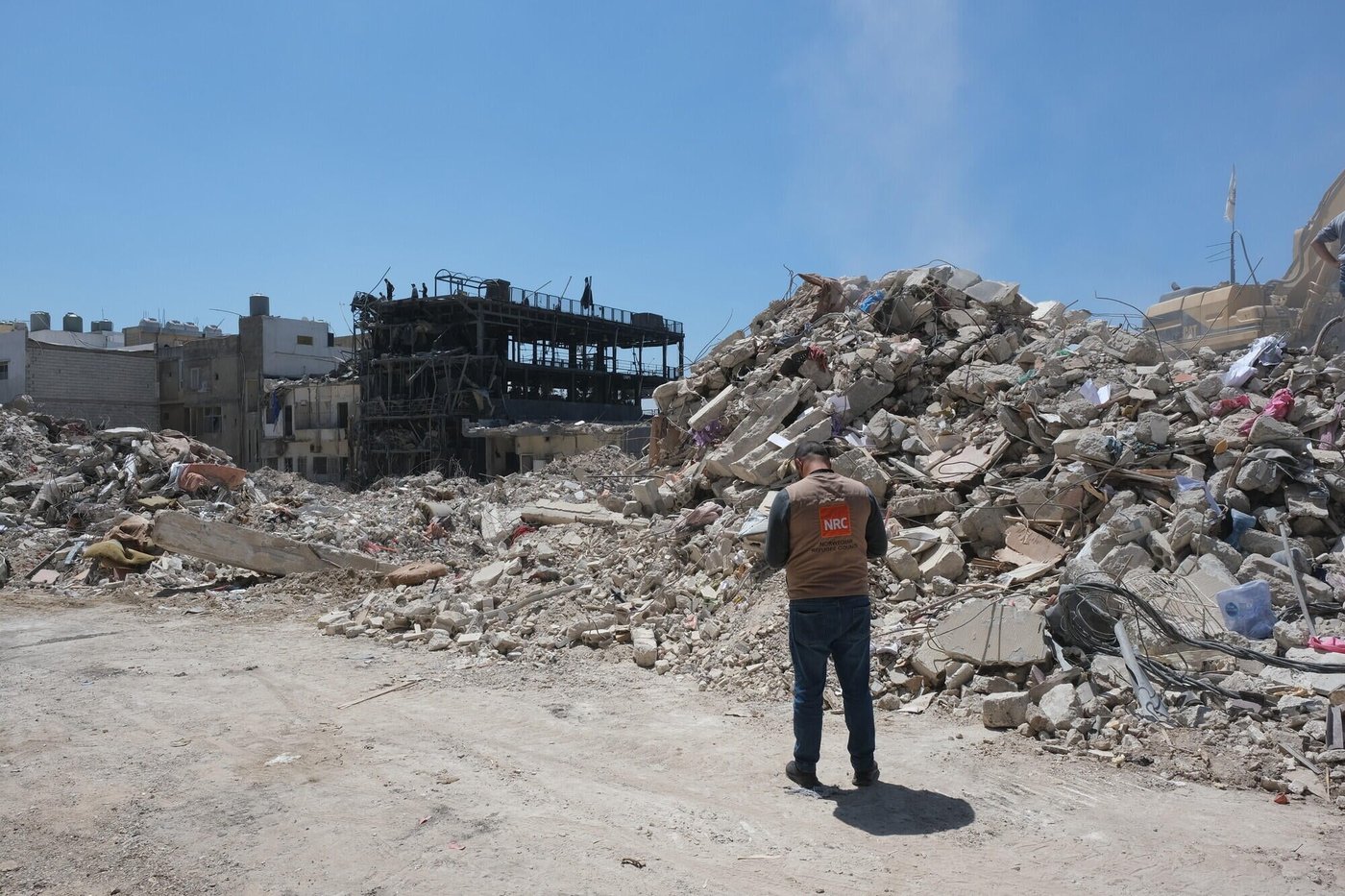
Lebanon: 100,000s unable to return amid continued military activity despite agreements
Ceasefire extensions have reduced the scale of attacks, but they have not made civilians safe. Since the latest Lebanon-Israel framework agreement, signed in Washington on 26 June, hostilities have continued through Israeli shelling, drone strikes, house demolitions and military operations.
Four months on, return is still not a simple step. Israeli-declared military zones inside Lebanon, unexploded ordnance and access restrictions are keeping many families from returning home safely. Others cannot return because their homes have been destroyed or basic services are unavailable.
“Our home was badly damaged, and we cannot afford to repair it,” said Afaf, who recently returned to her village of Sohmour in West Bekaa. “We barely have electricity, and our water tanks were destroyed, so we now have to bring water home in plastic containers. Honestly, we don’t feel like there’s a ceasefire. We still hear drones flying overhead all the time, as if nothing has changed.”
“The cost of recovery is being shaped by the way this war is being fought,” said Maureen Philippon, NRC Country Director in Lebanon. “When homes, roads, water systems, health facilities, schools and civilian infrastructure are destroyed, it means longer displacement, lost livelihoods, disrupted education, and families pushed deeper into debt. For civilians, the consequences will last long after attacks cease.”
Initial building damage assessments indicate that the cost of direct building damage south of the Litani River alone has reached 1.38 billion US dollars. This comes less than two years after the 2024 escalation, which had already left Lebanon facing billions of US dollars in damage and recovery needs.
“Families are exhausted after fleeing violence for the second time in less than two years,” said Philippon. “Many have depleted their savings to cope with displacement, whether to pay rent, buy clothes after leaving with almost nothing, or cover basic needs. This is happening in a country still recovering from one of the worst economic and financial crises. Every new attack makes recovery harder and more costly. Families need sustained funding to repair homes, restore basic services and rebuild their lives. We need to see stronger international mobilisation than we saw after the 2024 escalation.”
NRC calls on states with influence over the parties to the conflict to use all diplomatic channels to secure a genuine and lasting end to hostilities, support accountability for violations of international humanitarian law, and ensure conditions that allow families to return safely and rebuild.
Without sustained support for displaced families and communities trying to recover, many people will remain trapped between unsafe return, destroyed homes and prolonged displacement.
Notes to editors
-
Hostilities between Israel and Hezbollah escalated in Lebanon on 2 March 2026, marking the second major escalation in less than two years, following the 2024 escalation.
-
As of 25 June, 704,445 people remained internally displaced nationwide, while more than 523,000 people had begun returning, often cautiously. (OCHA)
-
A ceasefire between Israel and Hezbollah was first announced on 16 April after 46 days of escalation and was later followed by several extensions.
-
A Lebanon-Israel framework agreement was signed in Washington on 26 June. (Reuters)
-
The Ministry of Public Health reported more than 4,278 people killed and 12,196 injured since 2 March, including 135 health workers killed and 406 injured as of 30 June.(MOPH)
-
Building-level damage assessments by Lebanon’s National Council for Scientific Research (CNRS) and UNDP indicate that direct building damage south of the Litani River alone was valued at USD 1.38 billion as of 29 April. This does not capture the full scale of damage to essential infrastructure or other affected areas across Lebanon. (UNDP)
-
According to the World Bank’s Lebanon Rapid Damage and Needs Assessment, the 2024 escalation left Lebanon with an estimated US$6.8 billion in physical damage and US$11 billion in reconstruction and recovery needs. (WorldBank)
-
The 2026 Lebanon Flash Appeal, extended to August, requires USD 639.9 million and is only 37.1 per cent funded. (FTS)
For more information or to arrange an interview, please contact
-
NRC global media hotline: media@nrc.no, +47 905 62 329
