


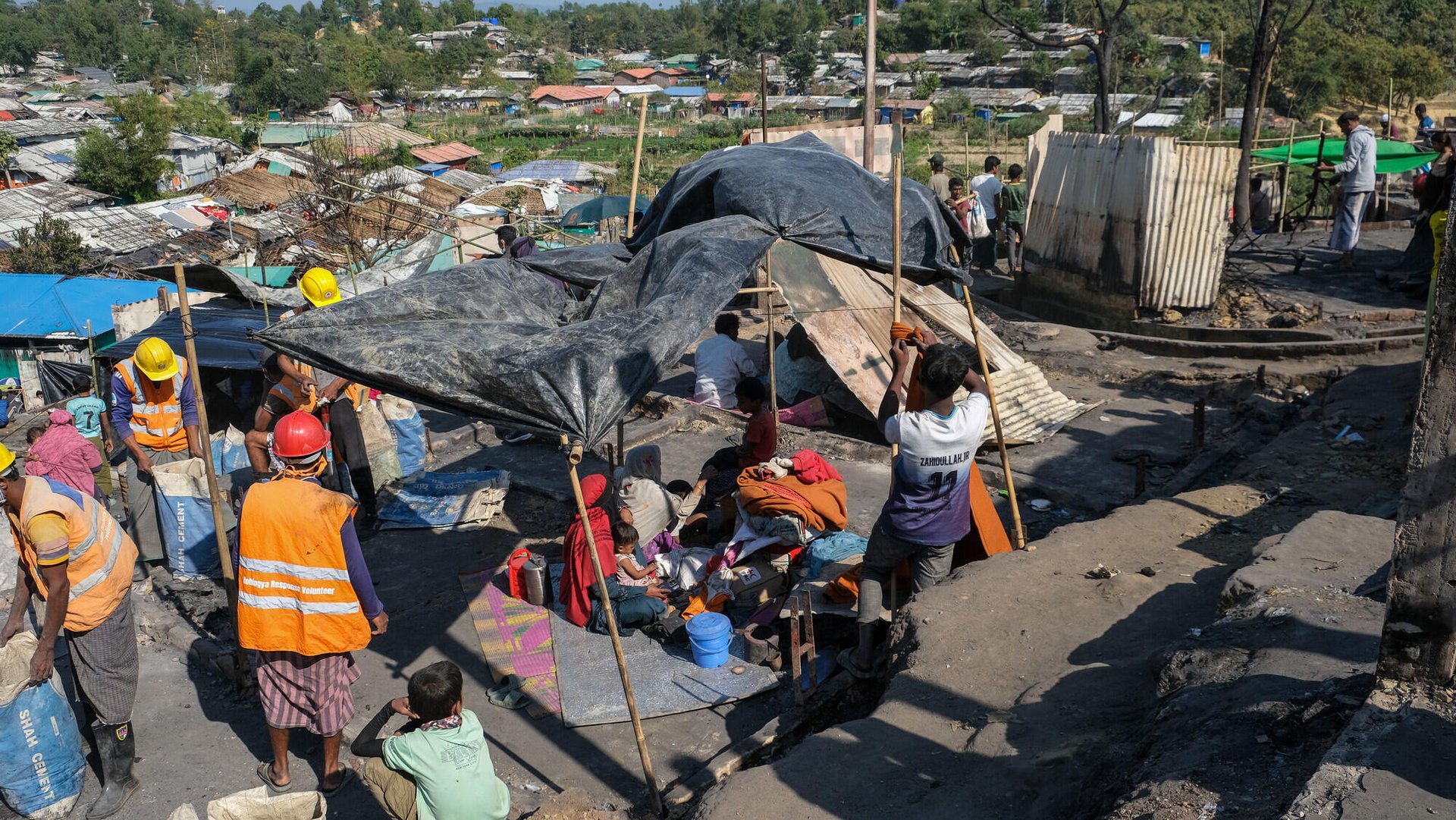
Another massive fire in Cox’s Bazar highlights the extreme vulnerability of Rohingya refugees living in overcrowded, makeshift homes - and the need for safer shelter.
A massive fire broke out around 3:00 AM on 20 January 2026 in Camp 16, Cox’s Bazar, Bangladesh, home to thousands of Rohingya refugees. The fire destroyed 335 homes and everything in them, and damaging hundreds more. More than 2,000 people have been affected. All families living in the destroyed homes have been forced to relocate to relatives or friends.
“This fire highlights the extreme vulnerability of Rohingya refugees living in overcrowded, makeshift homes that burn rapidly and offer little protection. A single spark can devastate entire sections of the camp, further exhausting already vulnerable families,” said Dipankar Datta, NRC’s country director in Bangladesh.
“Families have been living in these fragile shelters for years. They are entitled to safety and dignity and should not have to live in constant uncertainty. Without new funding, we simply cannot rebuild the homes people urgently need.”
The fire spread quickly through Blocks D2, D3, and D4, fueled by highly flammable materials such as bamboo and polythene and densely packed structures. In addition to destroyed homes, the blaze severely damaged critical facilities, including 86 latrines, 68 bathing cubicles, 11 water points, 40 solar streetlights, 10 learning centres, and 2 mosques/madrasas.
“My entire shelter was destroyed in the fire. Our bed, cooking utensils, and clothes were burned to ashes. I don’t know how and where my family and I will spend tonight,” said Nur Mohammad, a refugee living in Camp 16.
For years, Rohingya refugees have been living in fragile, makeshift shelters due to delays in approving improved shelter designs. Similar fires over the years have affected more than 100,000 people and destroyed 20,000 homes.
In December 2024, the Interim Government of Bangladesh approved three new semi-permanent shelter models that were intended to support the reconstruction of 50,000 safer shelters across the camps.
However, major humanitarian funding cuts announced in January 2025 halted the reconstruction plan, leaving the response critically underfunded. In 2025, just half of the required funding for the Rohingya response was delivered resulting in a funding gap of US $466.6 million. Without adequate funding, humanitarian organisations cannot rebuild these safer structures, leaving families trapped in shelters that cannot withstand fire, storms, or monsoon conditions.
“The government’s approval of new shelter designs was a hopeful moment for the Rohingya community. We don’t want that progress to stop. With donor support, we can give families a safer place to live,” said Datta.
“Funding now needs to be urgently stepped up so we can resume construction of the 50,000 approved semi-permanent shelters. Without immediate action, fires like this one in Camp 16 in Cox’s Bazar, will continue to threaten lives and force families to rebuild from nothing again and again.”
Notes to editors
-
Photos and videos from the affected camp following the first are available for use here.
-
The fire occurred at 03:00 AM on 20 January 2026 in Camp 16, Cox’s Bazar, affecting Blocks D2, D3, and D4. 335 shelters were fully destroyed and 72 shelters partially damaged. Additional facilities damaged include: 86 latrines, 68 bathing cubicles, 11 water points, 40 solar streetlights, 10 learning centres, and 2 mosques/madrasas (Inter-Sector Coordination Group).
-
A total of 407 households self‑relocated to friends and family after losing their shelters (Inter-Sector Coordination Group).
-
The cause of the fire is unknown currently.
-
Between May 2018 and December 2025, a total of 2,425 fire incidents were recorded, affecting over 100,000 individuals, damaging more than 20,000 shelters, and causing significant loss of life, displacement, and infrastructure (Rohingya Response).
-
The Interim Government of Bangladesh approved three new semi‑permanent shelter designs in December 2024, intended to support the reconstruction of 50,000 shelters (UNHCR).
-
In January 2025, major humanitarian funding cuts were announced, halting the reconstruction of the 50,000 planned semi‑permanent shelters (AP).
-
1,143,464 million Rohingya refugees live in Cox’s Bazar, the majority displaced since 2017 (UNHCR).
-
Most shelters in the camps are built from highly flammable bamboo and tarpaulin/polythene, designed originally to last 6–12 months.
- Humanitarian actors warn that declining funding will increase risks related to fires, monsoon storms, protection concerns, and overcrowding. In 2025, 50.1% of required funding for the Rohingya refugee response was provided. Just 19.6% of required funding for shelter projects was delivered (OCHA).
-
NRC is present in the affected camp with information and legal assistance as well as protection activities and is supporting the emergency response with jerrycans, other essential household items, such as steel plates, basic cooking utensils, and plastic buckets and dignity kits, which include essential hygiene items such as reusable sanitary pads, soap, toothpaste, and slippers, along with planned reconstruction of shelters and water and sanitation facilities, including rebuilding toilets.
For more information or to arrange an interview, please contact:
-
NRC global media hotline: media@nrc.no, +47 905 62 329
-
Michèle Carezis, Advocacy and Communication Manager in Bangladesh: michele.carezis@nrc.no, +880 1896 184523
